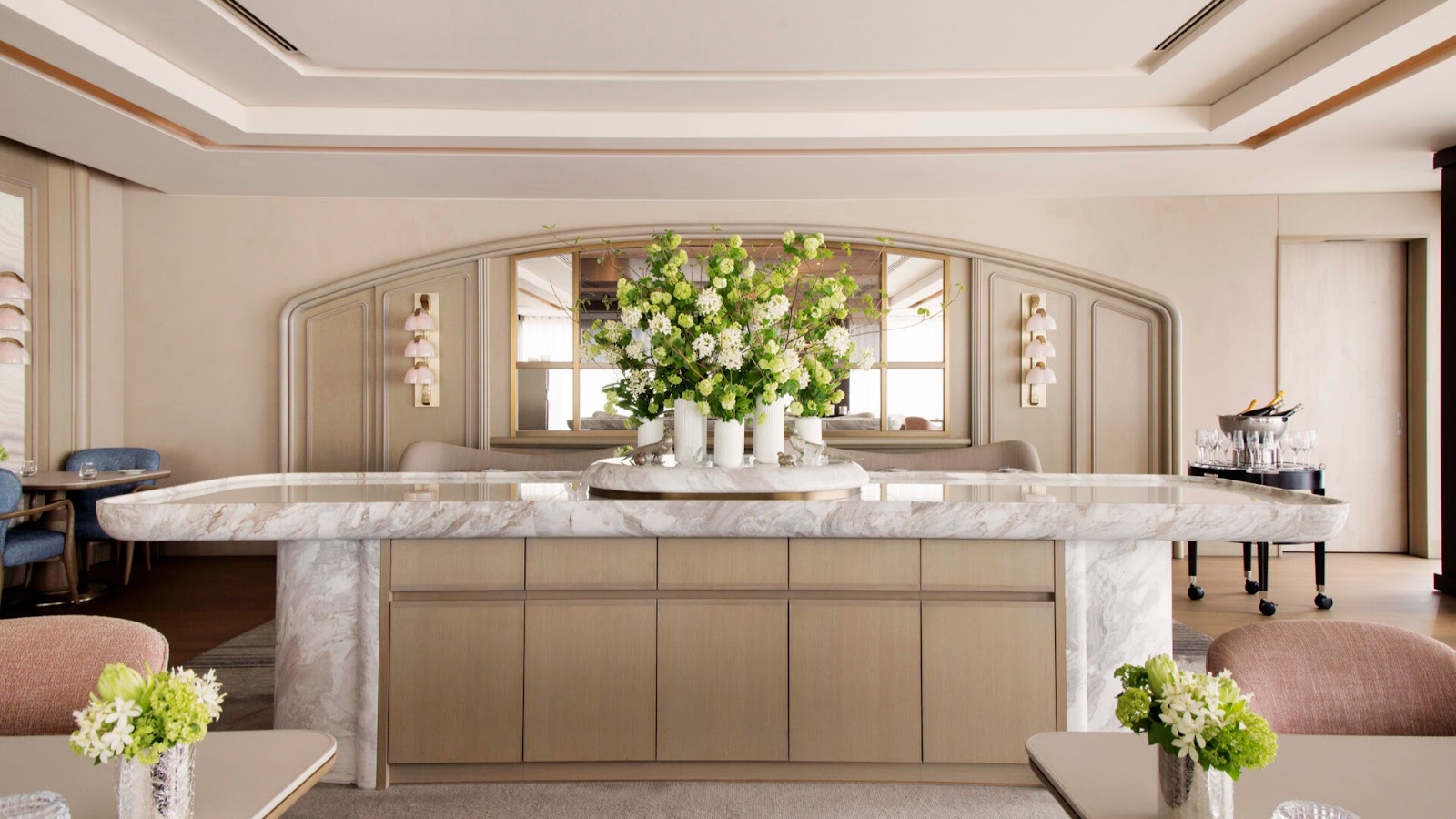
RFK Rankings · Tokyo
Best Restaurants Inside Hotels in Tokyo 2026
Hotel dining · Tokyo · 7 rooms ranked · Updated May 2026
Compiled by the Restaurants for Kings editorial team · Published December 23, 2022 · Updated May 30, 2026 · Reviewed by Fredrik Filipsson, Editor-in-Chief · How we rank · Corrections
The best French kitchen in Tokyo sits on the seventh floor of a hotel. So does the best Italian, several floors higher across town. For a city that keeps its star chefs in tiny independent counters, Tokyo hides a surprising amount of its top cooking inside hotels, where the high floors buy a skyline, the service runs deeper, and a concierge can hold a window table or fix a late checkout around dinner. These seven hotel rooms, ranked, are the ones worth booking for the food first and the address second, from a three-star French tasting menu to a 40th-floor kaiseki counter under the lights of Shinjuku.
1.Sezanne
The three-star French room on the Four Seasons Marunouchi's seventh floor, dinner near 44,000 yen; Tokyo's top hotel kitchen. Book it.
Sezanne sits on the seventh floor of the Four Seasons Hotel Tokyo at Marunouchi and holds three Michelin stars in the 2026 guide, a rating it reached in October 2024 only two years after opening. Daniel Calvert built the room and won those stars, then left at the end of March 2026; Stephen Lancaster took over as executive chef on April 1, 2026, inheriting a kitchen at the top of its powers. The cooking is French in technique and Japanese in larder, a long tasting menu drawn from Hokkaido seafood, Japanese game and a famous bread service. Dinner runs near 44,000 yen, with a private Chef's Room at 101,200 yen. Book the seventh floor weeks ahead, and take a window seat over the Marunouchi rooftops.
Reserve via the Four Seasons Marunouchi several weeks ahead. Reserve →
2.Pierre Gagnaire
Pierre Gagnaire's two-star room on the ANA InterContinental's 36th floor, the Grand Dessert finale, near 30,000 yen. Reserve weeks ahead.
Pierre Gagnaire, the Saint-Etienne chef nicknamed the Picasso of the kitchen, holds two Michelin stars at his Tokyo room on the 36th floor of the ANA InterContinental in Akasaka. The cooking is recognisably his: a restless, many-plate style where a single course arrives as five small dishes meant to be eaten in sequence. The finale is the Grand Dessert, a procession of patisserie that lands as a dozen separate sweets at once and remains his global signature. Dinner runs near 30,000 yen, with a view across the Akasaka towers from the upper floor. Reserve weeks ahead through the hotel, ask for a window table at dusk, and come hungry, because the multi-plate format covers a great deal of ground.
Book through the ANA InterContinental Tokyo. Reserve →
3.est
Guillaume Bracaval's one-star room on the Four Seasons Otemachi's 39th floor, near 30,000 yen; four straight starred years. Try it once.
est occupies the 39th floor of the Four Seasons Hotel Tokyo at Otemachi, where chef Guillaume Bracaval has held one Michelin star for four consecutive years through the 2026 guide. Bracaval trained in Paris under Alain Passard, Christian Le Squer and Bernard Pacaud, and his menu is built on single ingredients at their peak, with around 95 percent of produce sourced from Japanese farmers, fishermen and foragers. The format is a tight seasonal tasting menu, drawn that week from what those suppliers send, served in a glass-walled room high over the Otemachi towers. Dinner runs near 30,000 yen. Try it once for a quieter, more produce-led alternative to the bigger names, book through the Four Seasons Otemachi, and request a table by the glass.
Reserve via the Four Seasons Otemachi two to three weeks ahead. Reserve →
4.Esterre
Alain Ducasse's one-star room at the Palace Hotel, the seasonal cookpot a signature, from 23,000 yen. Go for the cookpot.
Esterre is the Tokyo room of Alain Ducasse, run with Ducasse Paris on the ground floor of the Palace Hotel Tokyo overlooking the Imperial Palace moat at Wadakura, and it carries one Michelin star in the 2026 guide. The cooking is contemporary French built on Japanese produce, lighter and more vegetable-forward than the classic Ducasse template. The signature is the cookpot, a slow-cooked pot of seasonal vegetables and grains that Ducasse has carried across his restaurants for years, alongside line-caught Japanese fish. Dinner starts near 23,000 yen, before a service charge. The garden-facing room is one of the calmest grand settings in the city. Go for the cookpot and a moat-side table, and book two to three weeks ahead through the Palace Hotel.
Reserve through the Palace Hotel Tokyo. Reserve →
5.Il Ristorante – Niko Romito
Niko Romito's one-star Italian room atop the Bvlgari Hotel in Yaesu, the onion 'assoluto' near 25,000 yen. Worth the trip up.
Il Ristorante at the Bvlgari Hotel Tokyo sits on the 40th floor of the Tokyo Midtown Yaesu tower and holds one Michelin star, awarded in the Tokyo 2025 guide and retained for 2026. The kitchen follows the template of Niko Romito, whose Reale in Abruzzo holds three stars, and renders it in a contemporary Italian register: deceptively simple plates built on a few perfect components. The Assoluto di cipolle, an 'absolute' of slow-cooked onions reduced to a clear, intense essence, is the Romito dish to order, with the roast lamb and the house panettone close behind. Dinner runs near 25,000 yen with a skyline view across Tokyo Station. Worth the trip up to the 40th floor, and book through the Bvlgari Hotel a few weeks out.
Reserve via the Bvlgari Hotel Tokyo. Reserve →
6.Kozue
The Park Hyatt's 40th-floor Japanese room, kuruma-ebi tempura and a Shinjuku skyline, 13,000 to 20,000 yen. Pencil it in.
Kozue occupies the 40th floor of the Park Hyatt Tokyo in Nishi-Shinjuku, the hotel that opened in 1994 and became famous worldwide through the 2003 film Lost in Translation. It carries no Michelin star, and it earns a place here on setting and consistency rather than on a chef's name: floor-to-ceiling windows that frame Mount Fuji on a clear day, and a modern Japanese kitchen that works the seasons without the formality of a kaiseki house. Kuruma-ebi tempura, seasonal sashimi and a long sake list are the draw, with courses running roughly 13,000 to 20,000 yen. This is the hotel room to book when the view is the occasion. Pencil it in for the view, request a window table at sunset, and let the room do the work.
Book through the Park Hyatt Tokyo and request a window table. Reserve →
7.Arva at Aman Tokyo
Aman Tokyo's 33rd-floor Italian room under a stone lobby, handmade pasta and a city view, from 12,000 yen. Fly in for it.
Arva is the Italian dining room of Aman Tokyo, which opened in December 2014 on the top floors of the Otemachi Tower and remains one of the city's most dramatic hotel spaces, a 30-metre lobby in stone, washi and water. The restaurant carries no Michelin star, so it sits here for its setting and its kitchen rather than a rating: a pan-regional Italian menu built on Japanese and imported produce, with handmade pasta and a strong antipasti table at its core. Lunch starts near 12,000 yen and dinner climbs from there, served beside windows that fall away over Otemachi and the palace grounds. Fly in for the room as much as the plate, take an early dinner for the light, and book through Aman Tokyo.
Reserve through Aman Tokyo in Otemachi. Reserve →
Avoid for this list
Hotel rooms that miss for serious dining
Hotel buffets and lobby lounges. Several grand Tokyo hotels push their all-day buffets and afternoon-tea lounges hard, and they are pleasant enough, but none is a destination dinner. If you are choosing a hotel restaurant for the cooking, skip the buffet floor and book one of the seven rooms above, where a named chef and a real menu justify the bill.
View bars sold as restaurants. A high-floor cocktail bar with a short kitchen menu is a fine nightcap and a poor dinner. Tokyo has many, and they trade on the window rather than the plate. For an actual meal with a view, Kozue and Arva deliver both; treat the rooftop bars as the drink before or after, not the reservation.
How to book a Tokyo hotel restaurant
The advantage of a hotel room is the concierge, so use it. Sezanne, est and Arva all book through their Four Seasons or Aman front desks, which can hold a window table, coordinate a birthday plate or arrange a car. Pierre Gagnaire goes through the ANA InterContinental, Esterre through the Palace Hotel, Niko Romito through the Bvlgari Hotel, and Kozue through the Park Hyatt. The starred rooms, Sezanne above all, need two to four weeks of lead time and reward the earlier dinner seating, when the kitchen is freshest and the light over the city is at its best.
Ask for a window table by name when you book, since the high floors are the whole point at Pierre Gagnaire, Niko Romito, Kozue and Arva. Flag dietary needs in advance, because the tasting menus at Sezanne and est are fixed and easier to adapt with notice than on the night. If you are staying in the hotel, mention it, as in-house guests often get first call on prime slots. For more Tokyo options, see the full Tokyo dining guide or the rooms best for impressing clients.
Frequently asked
What is the best hotel restaurant in Tokyo?
Sezanne is the top hotel restaurant in Tokyo. The French room on the seventh floor of the Four Seasons Hotel Tokyo at Marunouchi holds three Michelin stars in the 2026 guide, the highest rating of any hotel dining room in the city. Daniel Calvert built it and won the stars before leaving in March 2026, with Stephen Lancaster taking over as executive chef in April 2026. Dinner runs near 44,000 yen. Book several weeks ahead and request a window table over Marunouchi.
Which Tokyo hotel restaurants have Michelin stars?
Five rooms on this list are starred in the 2026 guide. Sezanne at the Four Seasons Marunouchi holds three stars, Pierre Gagnaire at the ANA InterContinental holds two, and est at the Four Seasons Otemachi, Esterre at the Palace Hotel and Il Ristorante Niko Romito at the Bvlgari Hotel each hold one. Kozue at the Park Hyatt and Arva at Aman Tokyo carry no star but earn their places on setting and consistency. For the cooking alone, the five starred rooms lead.
How much does dinner cost at a Tokyo hotel restaurant?
Plan on 12,000 to 44,000 yen a head before drinks. Arva at Aman starts near 12,000 yen and Kozue near 13,000 yen, Esterre from 23,000 yen, Niko Romito near 25,000 yen, est and Pierre Gagnaire near 30,000 yen, and three-star Sezanne near 44,000 yen, with its private Chef's Room at 101,200 yen. Service charges and pairings add to that. For value against rating, Esterre's one-star menu from 23,000 yen is the pick.
Do you need to be a hotel guest to dine at these restaurants?
No. Every room on this list is open to outside diners, and you do not need to be staying at the hotel to book. That said, in-house guests often get first access to prime slots and window tables, so if you are staying at the Four Seasons, Park Hyatt, Palace, Bvlgari, ANA InterContinental or Aman, mention it when you reserve. Non-guests should book two to four weeks ahead for the starred rooms, especially Sezanne, and ask the concierge for a high-floor table.
Which Tokyo hotel restaurant has the best view?
Kozue and Arva lead for the view. Kozue sits on the 40th floor of the Park Hyatt in Nishi-Shinjuku, with windows that frame Mount Fuji on a clear day, and Arva crowns the Otemachi Tower at Aman Tokyo above a soaring stone lobby. Among the starred rooms, Il Ristorante Niko Romito on the Bvlgari Hotel's 40th floor and Pierre Gagnaire on the ANA InterContinental's 36th both pair serious cooking with a skyline. Book a window table and take the sunset seating.
Related rankings
More from RFK
Compare the worldwide ranking of hotel restaurants, browse the full Tokyo dining guide, see the rooms best for impressing clients, or open the full RFK rankings index.
Restaurants for Kings is reader-supported. Some reservation links are affiliate links with OpenTable, Resy or Tock; we earn a small commission at no cost to you, and a link never buys a place on a ranking. Editorial scores and ranking order are independent of any commercial relationship. See our ranking methodology.