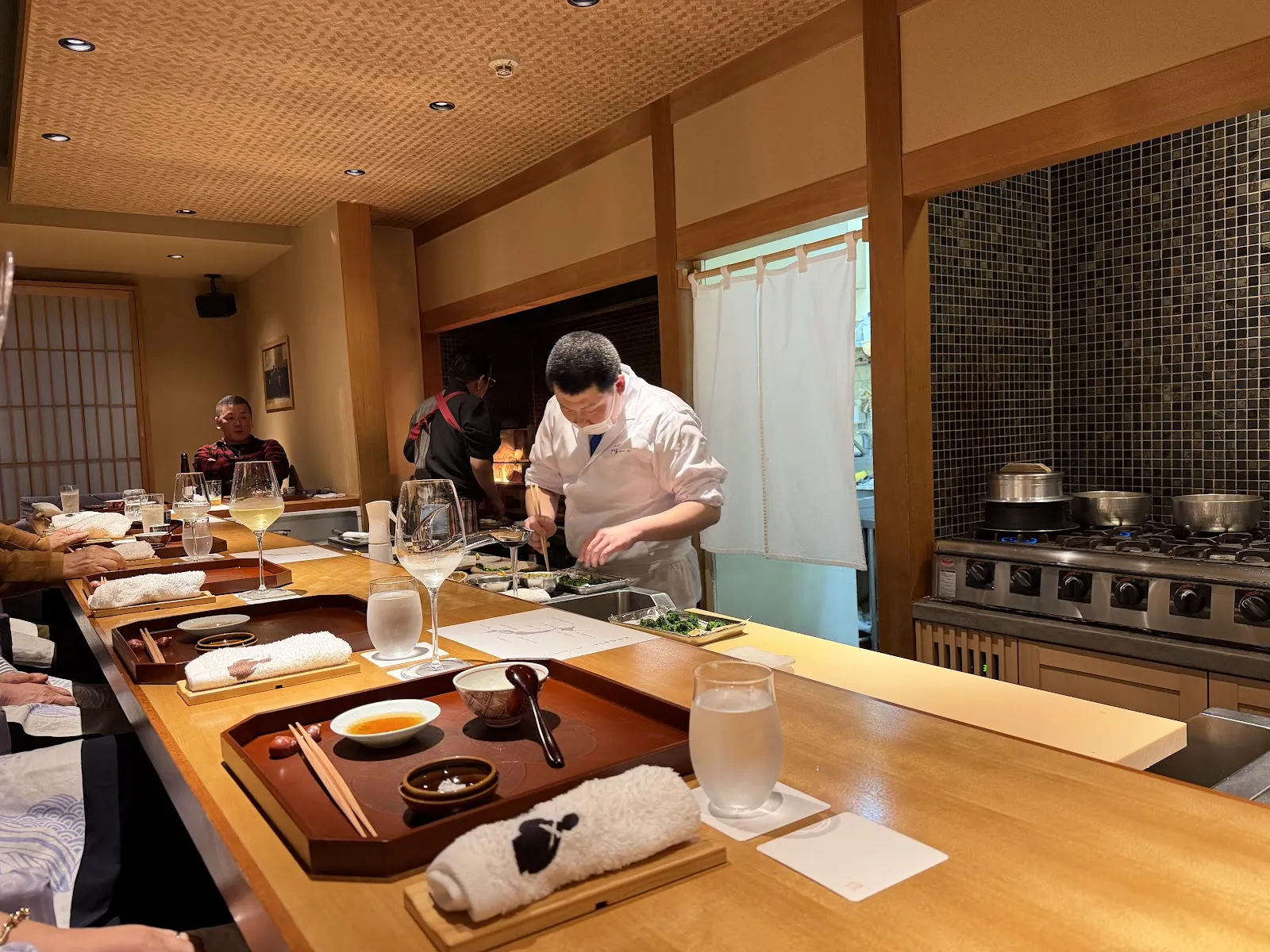
About Chisou Sottakuito
Dashi is the test, and Hisamasa Hirano treats it like one. The stock at Chisou Sottakuito is drawn from aged kombu and dried tuna, held at controlled extraction temperatures so the umami builds without turning bitter, and poured from Hiroshima's own spring water. Everything else on the eleven-course omakase is arranged around that broth rather than against it. The restaurant takes its name from sottaku, the instant a chick and the hen peck through the shell at once; the philosophy is timing, serving each ingredient at the exact moment it is ready. It holds a Michelin star and Tabelog Silver four years running, 2022 through 2025.
For the wider picture, see the Hiroshima dining guide, or compare the kaiseki at Seasonal Cuisine Nakashima.
The Kitchen
Hirano cooks an eleven-course omakase for ¥27,500, beverages extra, from a nine-seat counter where you watch every step. The dashi work shows in two dishes above all. The uni tofu arrives with clam broth from Kuwana, bafun sea urchin and a spoon of caviar, sweet and saline at once. The conger eel is grilled briefly over binchotan charcoal until the skin turns fragrant and the flesh stays soft. The Seto Inland Sea supplies much of the seafood, oysters through winter, and the menu turns with the Chugoku seasons. It costs a fraction of an equivalent Tokyo counter, which is part of why diners rank it where they do.
The Room
Nine seats at a wooden counter on the first floor of the Zuiki Building, 5-1 Fujimi-cho in Naka-ku, a short walk from Chuden-mae. The room is quiet and close, built for watching the chef work rather than for talking across a table. Dress smart; reservations open one to three weeks out and the nine seats go fast. Service runs in Japanese with enough English to guide a first-timer through the courses.
Best for a First Date
Book the counter for a first date with someone who cares how food is made. Nine seats means you sit shoulder to shoulder, the chef sets the pace, and the cooking gives you something to talk about between courses. The Michelin star and the price below Tokyo's signal a host who did the homework. See more first-date restaurants or tables to close a deal.
Not For
Skip it if you want a long, lingering dinner over conversation. This is a nine-seat counter, the omakase moves at the chef's pace, and the room is built to watch the cooking, not to talk across a table.
Common Questions
Is Chisou Sottakuito worth it? Yes, especially on value. It holds a Michelin star and Tabelog Silver from 2022 through 2025, and diners who know Tokyo say the cooking rivals two-star counters there at a fraction of the price. Chef Hisamasa Hirano's eleven-course omakase is ¥27,500, built on a dashi from aged kombu and tuna. For a dashi-led kaiseki meal, it is one of Hiroshima's best seats.
How much does it cost? The omakase is ¥27,500 for eleven courses, with drinks charged separately. Sake and wine pairings push the total higher. For a Michelin-starred counter of nine seats, that is well below the Tokyo equivalent, which is part of the appeal. Reserve one to three weeks ahead.
What should I order? It is a set omakase, so the chef decides, but the dishes to watch for are the uni tofu with Kuwana clam broth, bafun sea urchin and caviar, and the conger eel grilled over binchotan charcoal. Both show the kitchen's dashi and its control of heat.
How hard is it to book? Reserve one to three weeks ahead; there are only nine counter seats and they fill quickly, especially in oyster season. Booking through a reservation service or the restaurant directly is the surest route, and arrive on time as the omakase starts together.
What is the dress code? Smart dress is right for the room. There is no formal jacket rule, but this is a refined nine-seat counter, not a casual izakaya, so dress accordingly.