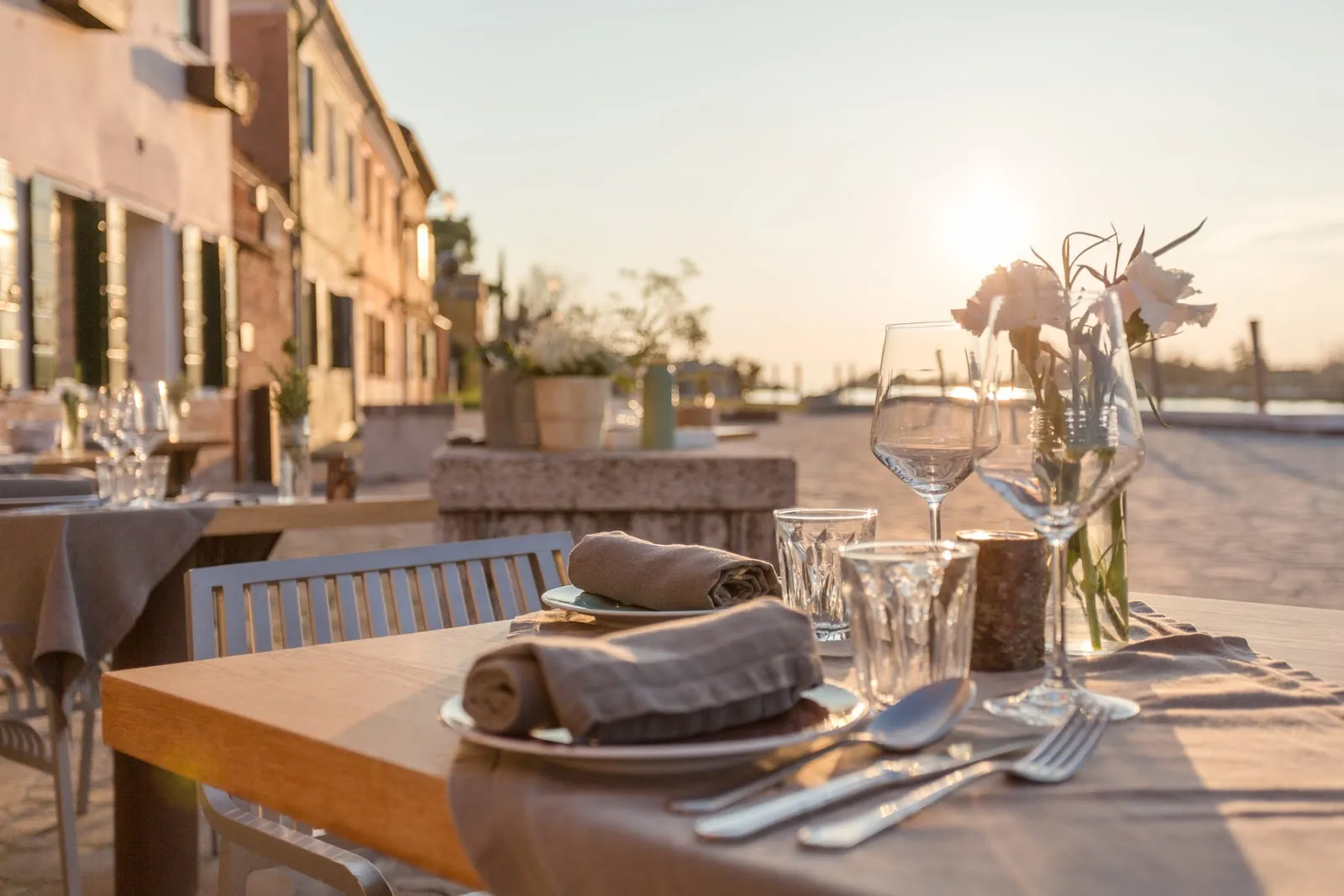
The Lagoon's Most Extraordinary Table
Venissa requires a journey. From Venice, the vaporetto to Mazzorbo takes forty-five minutes, long enough that the city recedes and the northern lagoon asserts its own logic. By the time the boat reaches the wooden fondamenta of the small island that shares a bridge with Burano, the air has changed. The light is different. The landscape has reduced itself to the essentials: water, reed beds, the occasional fishing boat, the distant haze of the Alps in winter. It is this journey that makes Venissa comprehensible. A restaurant serving this food on a Venice campo would be merely excellent. Here, the cooking is an argument about place, and the place makes the argument irresistible.
The restaurant occupies a walled vineyard dating to the Middle Ages, a private agricultural estate on an island that the twentieth century nearly abandoned before the Bisol family of Prosecco producers acquired and restored it in the early 2000s. The original Dorona grape, the golden-skinned variety that once covered the Venetian lagoon before phylloxera destroyed the region's vineyards in the late nineteenth century, was rediscovered here and cultivated back to productivity. The wine produced, Venissa DOC, is bottled with gold leaf and released in small quantities as one of the rarest and most distinctive Italian whites. Guests who dine at the restaurant will taste it; this is not optional, and the reason becomes clear within a glass.
Chefs Chiara Pavan and Francesco Brutto have been the kitchen's creative force since 2017, and the philosophy they term cucina ambientale, environmental cooking, is the most coherent articulation of place-based gastronomy produced by any Italian restaurant in recent years. The seven-course tasting menu from €165 and the ten-course version are designed as immersive experiences in the lagoon's ecology: herbs and vegetables from the estate garden and from the surrounding islands, fish and seafood from the Northern Adriatic and the lagoon's own waters, preparations that reference the traditional Venetian kitchen while departing from it with the confidence of chefs who understand exactly why they are departing.
Signature dishes shift with the seasons and the kitchen's evolving thinking, but certain preparations have become emblematic of the restaurant's approach. Gnocchi with fig leaf, unripened figs, and tarragon oil, a dish that operates in the register of sweetness and herb aromatics that the lagoon's spring produces. Castraure artichoke risotto with marinated egg yolk, artichoke coffee, and black garlic: the castraure are the first artichokes cut from each plant on the island of Sant'Erasmo, available only in April, and the dish is constructed as a showcase of their transience. A preparation of lagoon fish, often branzino or orate, with preparations using the salt marsh vegetation that grows at the lagoon's edges, where land and water negotiate their boundary continuously.
The double Michelin recognition, a star for culinary excellence and a Green Star for the ecological commitment that defines the kitchen's sourcing and waste practices, positions Venissa within the global movement of restaurants that are redefining what a kitchen's relationship to its landscape can mean. The Green Star is not decorative: the restaurant's compost, composting programme, elimination of single-use materials, and commitment to producers who share its ecological principles constitute a model of sustainability that the restaurant discusses without self-congratulation because the results are apparent in the food itself.
Why It Works for a Proposal
The journey is part of it. Arriving at Venissa by vaporetto across the northern lagoon, watching Venice disappear behind you and the islands of the lagoon resolve from haze into form, is an experience that frames everything that follows with a quality of departure from ordinary life. By the time you are seated in the vineyard dining room, surrounded by the Dorona vines, the kitchen's garden visible through the windows, the water visible beyond the walls, the moment exists in its own category, removed from the city's usual register of romance.
The tasting menu provides a pace and structure that serves the emotional arc of a proposal dinner: enough courses to allow the meal to breathe, each one different enough from the last to maintain attention without overwhelming it. The wine pairing, anchored by the estate's own Dorona, gives the evening a local and irreplaceable quality. The service is warm and attentive without being formal, Venissa's team understands that guests have made a journey to be here and deserve the room that arrival earns. When the lagoon turns gold at dusk as seen from the garden, the case is closed.
Community Reviews
"I planned this for six months. The vaporetto journey, the walk to the vineyard, the moment the gate opened and she saw the walled garden for the first time. I asked before the dessert course. The Dorona wine was in our glasses. She said yes. Chiara Pavan came out of the kitchen to congratulate us. I cannot imagine any other table in Europe."
"The castraure artichoke risotto in April is the single most completely achieved dish I have eaten in Italy. The balance of the artichoke coffee against the sweetness of the marinated yolk is a piece of kitchen thinking that no amount of technique alone explains, you have to know why the castraure matters to cook it this way."
"We took the vaporetto together as our first proper outing. Neither of us knew what to expect. The vineyard, the Dorona, the lagoon fish prepared with salt marsh herbs, everything was calibrated to make us pay attention, which is what a first date requires. The journey back across the lagoon in the dark was its own third act."
Restaurant Details
Closed winter months, check ahead
Best Occasion for Venissa?
Proposal First Date Birthday Solo Dining Impress ClientsJoin to vote and see community results.